

Introduction
Artificial intelligence is advancing faster than most people expected. Machines can now write, analyze data, recognize faces, and even create art. This rapid growth has sparked a major question: AI vs Humans, who is actually smarter?
Some believe artificial intelligence is already surpassing human abilities, while others argue that human intelligence remains unmatched. This article takes a clear, balanced, and factual look at the debate to help you understand where AI truly stands compared to humans.
What Is Human Intelligence?
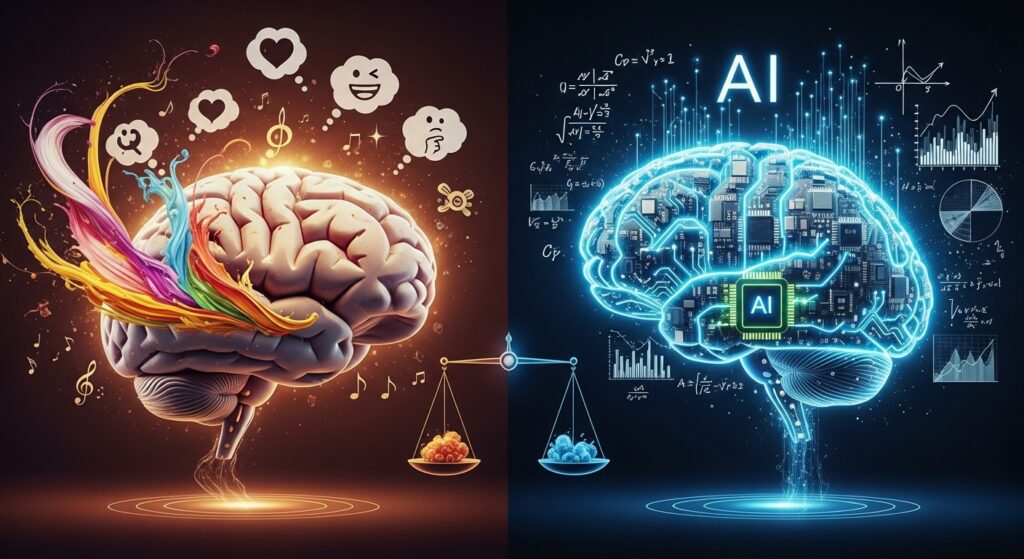
Human intelligence is complex and deeply rooted in biology, experience, and emotion. It is not limited to solving problems or processing information. Instead, it involves understanding, reasoning, learning, adapting, and making judgments in unpredictable situations.
How Humans Learn and Think
Humans learn through experience, observation, and reflection. Unlike machines, people do not rely solely on data. They learn from mistakes, emotions, social interactions, and personal memories. This difference is often highlighted when discussing human intelligence vs artificial intelligence. A human can understand context, adapt to new situations instantly, and apply knowledge creatively without needing millions of examples.
Humans also think abstractly. This means they can imagine things that do not exist, plan for long-term outcomes, and connect ideas across unrelated areas. This ability plays a major role in innovation, leadership, and creativity.
Emotions, Creativity, and Judgment in Humans
Emotions are a core part of human intelligence. They influence decision-making, relationships, and moral judgment. Humans can feel empathy, guilt, joy, and compassion. These emotions help people understand others and act responsibly in complex social situations.
Creativity is another major human strength, especially when viewed through the lens of AI vs Humans. People create music, stories, inventions, and art based on imagination and lived experience. This type of creativity is not just pattern-based. It is emotional, intentional, and meaningful.
What Is Artificial Intelligence?
Artificial intelligence refers to machines designed to perform tasks that normally require human intelligence. This concept is commonly explained as what is artificial intelligence, covering tasks such as recognizing speech, analyzing images, translating languages, and making predictions based on data.
How Artificial Intelligence Works
AI works by processing large amounts of data using algorithms. These algorithms identify patterns and relationships within the data. Once trained, an AI system can make predictions or decisions when it encounters new information.
Unlike humans, AI does not understand information. It calculates probabilities. It does not think or feel. It follows mathematical rules created by humans.
Types of Artificial Intelligence Explained
There are different types of AI, but most systems today fall under narrow AI. Narrow AI is designed for specific tasks, such as voice assistants or recommendation systems. It performs well within its defined limits but cannot think beyond its programmed scope.
AI vs Humans: Intelligence Comparison
When comparing AI vs Humans, it is important to examine specific abilities rather than general claims. Intelligence is not a single skill. It includes speed, creativity, learning, decision-making, and ethics.
Speed and Data Processing
AI can process information far faster than humans. It can analyze millions of data points in seconds. This makes AI extremely effective in areas such as data analysis, medical imaging, and financial forecasting.
Humans, however, process information more slowly. At the same time, they can filter what matters and ignore irrelevant details. This selective thinking often leads to better judgment in real-world situations.
Creativity and Emotional Understanding
AI can generate images, text, and music by analyzing patterns. However, this is not true creativity. AI does not feel emotions or understand meaning. It imitates styles based on existing data, a difference often discussed under AI creativity vs human creativity.
Decision-Making and Ethics
AI makes decisions based on rules and probabilities. It does not understand right or wrong. Ethical decisions still require human judgment.
Humans consider values, consequences, and emotions when making choices. This makes human intelligence essential in areas such as law, healthcare, leadership, and governance.
| Feature | AI | Humans |
| Speed | Extremely fast | Moderate |
| Emotions | None | Deep and complex |
| Creativity | Pattern-based | Original and meaningful |
| Ethics | Rule-based | Value-driven |
| Adaptability | Limited | High |
Is AI Smarter Than Humans Today?
This question is common, but the answer depends on how intelligence is defined.
Areas Where AI Performs Better
AI outperforms humans in tasks that involve large datasets and repetitive calculations, a clear advantage often noted in AI vs Humans comparisons. Examples include analyzing medical scans, detecting fraud, and optimizing logistics. In these areas, AI is faster, more consistent, and less prone to fatigue.
Areas Where Humans Are Still Smarter
Humans excel at understanding context, emotions, and complex social dynamics. They can solve new problems without prior data and adapt instantly to unfamiliar situations.
Humans also demonstrate moral reasoning, empathy, and creativity, qualities that AI cannot replicate. In unpredictable environments, human intelligence remains superior.
Can AI Think Like Humans?
Despite impressive performance, AI does not think like humans.
Why AI Does Not Have Consciousness
AI does not possess awareness. It does not know that it exists. It does not experience thoughts or emotions. Every action an AI takes is based entirely on programming and data, a limitation often discussed in relation to the concept of artificial consciousness.
Human consciousness involves self-awareness, emotions, and subjective experience. These qualities are biological and not yet fully understood, making them impossible to replicate artificially.
Limits of Artificial Intelligence
AI systems depend entirely on the quality of their data and design. They cannot reason beyond their training or understand meaning and intention.
AI also struggles with common sense. Tasks that are simple for humans, such as interpreting sarcasm or understanding emotional cues, remain extremely difficult for machines.
Future of AI vs Human Intelligence

The future raises important questions about how AI and humans will coexist.
Will AI Ever Surpass Humans?
AI will continue to improve in speed and accuracy. It may outperform humans in more technical tasks. However, surpassing humans in general intelligence would require consciousness, emotions, and self-awareness. There is currently no evidence that this is possible.
Why Humans Will Always Matter
Humans define goals, values, and meaning. AI is a tool created to assist, not replace, human intelligence. The most effective future lies in collaboration, where humans provide direction and ethics, and AI delivers efficiency and analytical power.
Human intelligence is not just about speed or accuracy. It is about understanding life, making moral choices, and creating meaning.
Conclusion
The debate surrounding AI vs Humans often creates fear or unrealistic expectations. AI is extremely powerful in specific tasks, but it is not smarter than humans in a general sense. Human intelligence includes creativity, emotions, ethics, and consciousness, qualities that cannot be measured by data or speed alone.
AI will continue to enhance human capabilities, but intelligence goes beyond computation, a balance often discussed in the future of AI and humans. True intelligence is not measured by speed or data, but by the ability to choose wisely and act with purpose.